


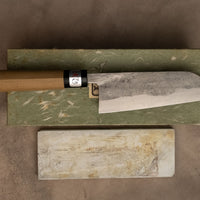
Fujiwara Santoku Shirogami #1 165mm (6.5")
🚩 Carbon steel develops a patina with use. This is normal, but the blade must be dried well to prevent rust.
|
✔︎ No import fees & duties (US tarrifs excluded) |

- Description
- Specifications
- Knife Care
- Shipping
Fujiwara Santoku Shirogami #1 165mm is a multi-purpose Japanese kitchen knife. It’s a beautiful expression of Japanese craftsmanship and the philosophy of wabi-sabi that blacksmith Teruyasu Fujiwara conveys through each of his pieces. Its blade is incredibly light, thin and razor-sharp, enabled by the Shirogami steel core, and its surface bears visible traces of the forging process.
Calling this piece a santoku admittedly does not tell the whole story. Its tip is more pronounced than the rounded tips usually found on santoku knives, and its cutting edge is very flat with minimal curvature at the belly. Measuring at 53 mm at the heel, its blade is also taller than most Japanese multi-purpose knives.
Therefore, this particular piece by Fujiwara-san lands somewhere between a santoku, a nakiri and a bunka in its functionality, as its sharp tip allows for precision work and its flat, tall blade is excellent for chopping vegetables.
STEEL:
Shirogami #1 is a traditional high-carbon steel. Due to its high carbon content, it can reach hardness levels up to 65 HRC, which means that blades forged from it will have excellent edge retention. It is renowned for its exceptionally fine sharpness, durability, and ability to hold a keen edge. Just keep in mind that this blade is a bit more delicate. So, make sure to follow some basic care and maintenance tips for Japanese knives when you're using it. Taking good care of it will keep it in top shape for a long time. → Read more about how to take care of high carbon knives and patina in our Knife maintenance blog post.
LAMINATION:
The blade was laminated with stainless steel. The outer layers are of softer, stainless steel, giving the knife extra rust protection.
GEOMETRY:
The knife features a symmetrical 50/50 (double bevel) edge with a traditional convex grind. This geometry provides excellent cutting performance while maintaining strength and smooth food release.
BLADE FINISH:
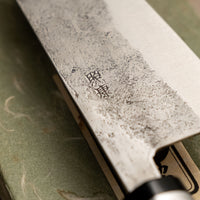
The blade finish adorning the knife’s blade is called Nashiji, the literal translation of the word being "the skin of an (Asian) pear." It refers to the slightly matted surface of the upper part of the blade, which is the result of the forging process. Besides the visual appeal, this finish also has practical value since the uneven surface reduces the sticking of the food to the blade when slicing.
HANDLE:
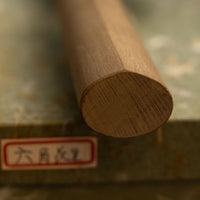
Blacksmiths decided to fit a traditional Japanese (Wa) wooden handle on this beautiful knife. It is made of magnolia wood with a black ferrule and D-shaped for improved ergonomics, but therefore slightly more suited for right-handed cooks.
BLACKSMITH:
The family-run Fujiwara smithy was established 140 years ago and produced mainly Japanese traditional swords. The biggest change came after World War II when the company and the successors had to shift focus from the forbidden craft of manufacturing katanas to hand forged kitchen knives.
The objective is the same nowadays as it was at the beginning - tradition and excellence. The fourth-generation blacksmith Teruyasu Fujiwara is intent on introducing the “soul of the katana” (and its sharpness) to today’s everyday tool, the knife. He forges the knives from start to finish on his own and was the pioneer of making blades with a carbon steel core and laminating them with stainless steel for better corrosion resistance.
Blade shape: Santoku
Steel type: Shirogami #1
Blade construction: San-Mai / convex / kuro-uchi
Hardness (HRC scale): 64-65
Overall length: 350mm (13.8")
Blade length: 165mm (6.5")
Blade height: 53mm (2.1")
Spine thickness: 2.99mm (0.12") → 1.3mm (0.05")
Weight: 110g (3.9 oz)
Handle length: 128mm (5")
Handle type / wood: Japanese (Wa) style / Magnolia
Kanji on the blade:
Blacksmith: Teruyasu Fujiwara
Location of the smithy: Tokyo / Tokyo Prefecture / Japan
☝️ Japanese kitchen knives in our store are handmade from natural materials. Slight variations in color, texture, weight and other dimensions are possible. We try to give a good photographic representation of our products, however computer screen resolution and colors do vary, so products might not look exactly as they are seen on screen.


☝️ THIS KNIFE MAY DEVELOP PATINA
Knives made of carbon steels can, due to their low chromium (Cr) content, discolor and develop patina. The knife is the most sensitive when it is still new and a patina had not developed yet, but later, patina will protect the blade. These types of knives require a touch more care:
✔ Wipe it regularly with a clean and dry cloth (you can also do this during use).
✔ After use, rinse it with lukewarm water and wipe it dry.
✔ Coat it regularly with knife maintenance oil or plain refined sunflower oil.
✔ Store the knife by wrapping it in paper which will absorb moisture and protect the blade.
A patina is a thin layer that forms on the surface of oxidized steel and protects it from further oxidation. The patina should not be confused with rust. Patina protects the blade, while rust causes corrosion and deterioration of material, so it should be removed (see Rust erasers).
→ For in-depth information about patina, read our dedicated post on patina.
GENERAL KNIFE CARE TIPS:
Blade wear depends on the quality of steel, usage and maintenance of the blade. Japanese knives are made of high-quality steels. Follow these tips to keep your Japanese knife in top-notch shape:
✔ Use a wooden, plastic or rubber cutting board.
✔ After use, wash the knives and wipe them dry.
✔ For storage, use a knife holder or a protective knife sheath (saya).
✔ A good cutting technique is your best bet to prolong sharpness.
✔ Use sharpening stones to sharpen the knife.
❗️Don’t leave the knife in the sink. Wash it by hand.
❗️Don’t wash the knife in the dishwasher.
❗️Don’t use the knife on glass, ceramics, marble or steel surfaces.
❗️Don’t scrape the food off the cutting board with the edge of the blade. Use the spine of the knife instead.
❗️Knife is a tool intended for specific use - cutting food. It is not a can opener, screwdriver, trowel, wire cutter, hammer etc.
→ For more details, read our guide
on Maintenance of Kitchen Knives.
🤙 Contact us if you need some help. We reply within 1 business day.
SHIPPING RATES:
- €10 - flat worldwide rate with DHL Express (express delivery, 2-5 business days).
- FREE - all orders over €300 (DHL Express).
EXCEPTIONS:
See our Shipping page for more details.
DUTIES AND IMPORT TAXES:
We ship all orders DDP (duties & taxes paid). This means you will not be charged for any import fees and taxes (including VAT). All our prices are final. The price you see at checkout is the final price, no hidden costs.
DELIVERY TIME:
- Europe: 1-2 business days
- US & Canada: 2-4 business days
- Rest of the World: 3-5 business days
RETURNS:
Our return policy lasts 30 days. If more than 30 days have gone by since the day you received your order, unfortunately we can’t offer you a refund or exchange.
→ Read our SHIPPING & RETURNS policy for more info. We strive to solve any issues fast and with as little hassle for you. If you have some additional questions, please contact us.
Each knife comes with:
✔️ Instructions and knife care leaflet.
✔️ A preventive Band-Aid – the knives are very sharp! 😉
✔️ Original box from the blacksmith, which we wrap in an old Japanese newspaper sheet – so every knife is ready to be passed on as a gift as soon as it hits your doorstep!
✔️ We also offer a special gift wrapping option with the traditional Japanese washi paper.
Still not sure?
Take our 5-step quiz and find your match
Get a personalised recommendation.
Take the quiz