


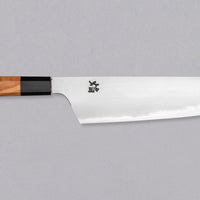
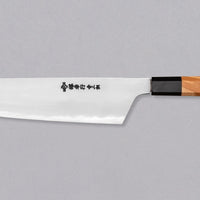
Homura Kogetsu Gyuto Aogami #2 Kasumi 240mm (9.4")
🚩 This blade will develop patina with use, while improper maintenance may lead to rust formation.
|
✔︎ No import fees & duties (US tarrifs excluded) |

- Description
- Specifications
- Knife Care
- Shipping
This is not just a basic Japanese knife with a prettier handle. The higher price is the result of the choice of steel, a demanding forging process, the complexity of the finishing treatment, and the extensive handwork involved. It was handcrafted by Itsuo Doi, one of Sakai’s most respected master blacksmiths and the artisan behind the Homura series by Sakai Takayuki.
Itsuo Doi is the son and successor of Keijiro Doi, a legendary Sakai blacksmith synonymous with the highest level of craftsmanship. Having trained under him from a young age, Itsuo learned his father’s signature low-temperature forging method. Rather than overheating steel to quickly shape a blade, Itsuo carefully heats the steel only as much as necessary during forging. This process helps preserve the steel’s fine grain structure, resulting in blades with outstanding edge stability, durability, and ease of sharpening. He is especially proficient in working with Aogami #2, which is also the steel of choice for this beautiful gyuto.
BLADE SHAPE:
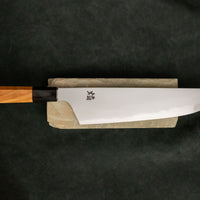
Doi-san is known for his creative, slightly unconventional takes on classic Japanese knife shapes. This gyuto is no different, featuring a subtly sloped heel, as well as an elegantly upswept sakimaru tip and a pronounced, flowing belly. The blade's balanced curvature is optimized for the rocking technique, enabling smooth, controlled cuts.
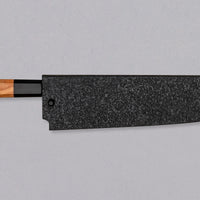
Plastic Saya is included.
STEEL:
Aogami #2 is one of the finest high-carbon steels, meaning the knives forged from it will have excellent edge retention and also sharpen very easily. At the same time, it is less resistant to corrosion, meaning the blade will develop a patina, while longer exposure to water or other corrosives could also lead to rusting. This is improved to some extent with the addition of chromium and tungsten, but it’s still a high-carbon steel that should be maintained accordingly.
LAMINATION:
The core layer consisting of the harder Aogami #2 steel was sandwiched between two layers of softer steel. This technique is called san-mai and is used to protect the hard (but delicate) core from outside factors and physical impacts, which could lead to breakage.
GEOMETRY:
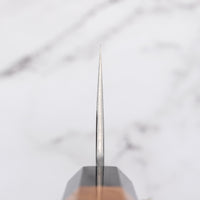
It has a double-bevel blade with a slightly concave V-edge profile (hollow grind); this allows the knife to remain extremely thin despite frequent sharpening. The symmetrical edge makes the knife suitable for both left- and right-handed users.
BLADE FINISH:
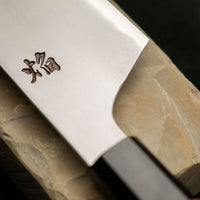
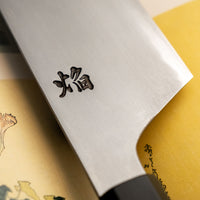
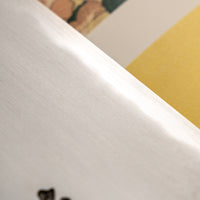
The cutting edge was treated to a high, reflective polish that provides a beautiful contrast to the hazy kasumi finish on the upper part of the blade.
HANDLE:
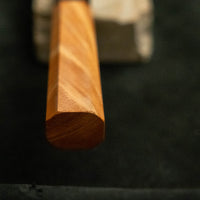
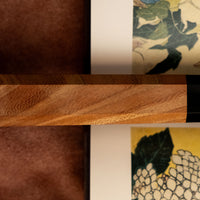
The traditional octagonal wa-handle is carved from premium ichii (Japanese yew) wood, valued in Japanese craftsmanship for its rich, warm appearance and natural water resistance. It is completed with a polished buffalo horn ferrule.
The knife’s authentic look is further distinguished by a “machi" gap—the visible space between the ferrule and the blade’s neck. In Sakai-made knives, especially single-bevel knives, the machi gap is part of the forging tradition and is seen as a mark of authentic hand craftsmanship rather than machine assembly.
Blade shape: Gyuto
Steel type: AUS-10
Blade construction: San-mai / kasumi
Hardness (HRC scale): 62-63
Overall length: 399mm (15.7")
Blade length: 240mm (9.4")
Blade height: 55mm (2.2")
Spine thickness: 2.5mm (0.1")
Weight: 210.0
Handle length: 140mm (5.5")
Handle type / wood: Japanese / yew
Kanji on the blade:
Blacksmith: Itsuo Doi
Location of the smithy: Sakai / Kōchi Prefecture / Japan
☝️ Japanese kitchen knives in our store are handmade from natural materials. Slight variations in color, texture, weight and other dimensions are possible. We try to give a good photographic representation of our products, however computer screen resolution and colors do vary, so products might not look exactly as they are seen on screen.


☝️ THIS KNIFE MAY DEVELOP PATINA
Knives made of carbon steels can, due to their low chromium (Cr) content, discolor and develop patina. The knife is the most sensitive when it is still new and a patina had not developed yet, but later, patina will protect the blade. These types of knives require a touch more care:
✔ Wipe it regularly with a clean and dry cloth (you can also do this during use).
✔ After use, rinse it with lukewarm water and wipe it dry.
✔ Coat it regularly with knife maintenance oil or plain refined sunflower oil.
✔ Store the knife by wrapping it in paper which will absorb moisture and protect the blade.
A patina is a thin layer that forms on the surface of oxidized steel and protects it from further oxidation. The patina should not be confused with rust. Patina protects the blade, while rust causes corrosion and deterioration of material, so it should be removed (see Rust erasers).
→ For in-depth information about patina, read our dedicated post on patina.
GENERAL KNIFE CARE TIPS:
Blade wear depends on the quality of steel, usage and maintenance of the blade. Japanese knives are made of high-quality steels. Follow these tips to keep your Japanese knife in top-notch shape:
✔ Use a wooden, plastic or rubber cutting board.
✔ After use, wash the knives and wipe them dry.
✔ For storage, use a knife holder or a protective knife sheath (saya).
✔ A good cutting technique is your best bet to prolong sharpness.
✔ Use sharpening stones to sharpen the knife.
❗️Don’t leave the knife in the sink. Wash it by hand.
❗️Don’t wash the knife in the dishwasher.
❗️Don’t use the knife on glass, ceramics, marble or steel surfaces.
❗️Don’t scrape the food off the cutting board with the edge of the blade. Use the spine of the knife instead.
❗️Knife is a tool intended for specific use - cutting food. It is not a can opener, screwdriver, trowel, wire cutter, hammer etc.
→ For more details, read our guide
on Maintenance of Kitchen Knives.
🤙 Contact us if you need some help. We reply within 1 business day.
SHIPPING RATES:
- €10 - flat worldwide rate with DHL Express (express delivery, 2-5 business days).
- FREE - all orders over €300 (DHL Express).
EXCEPTIONS:
See our Shipping page for more details.
DUTIES AND IMPORT TAXES:
We ship all orders DDP (duties & taxes paid). This means you will not be charged for any import fees and taxes (including VAT). All our prices are final. The price you see at checkout is the final price, no hidden costs.
DELIVERY TIME:
- Europe: 1-2 business days
- US & Canada: 2-4 business days
- Rest of the World: 3-5 business days
RETURNS:
Our return policy lasts 30 days. If more than 30 days have gone by since the day you received your order, unfortunately we can’t offer you a refund or exchange.
→ Read our SHIPPING & RETURNS policy for more info. We strive to solve any issues fast and with as little hassle for you. If you have some additional questions, please contact us.
Each knife comes with:
✔️ Instructions and knife care leaflet.
✔️ A preventive Band-Aid – the knives are very sharp! 😉
✔️ Original box from the blacksmith, which we wrap in an old Japanese newspaper sheet – so every knife is ready to be passed on as a gift as soon as it hits your doorstep!
✔️ We also offer a special gift wrapping option with the traditional Japanese washi paper.
Quiz
Still doubting which type of Japanese knife should best fit your needs?
We created a 5-steps quiz to help you find the perfect knife based on your cooking skills and the type of food you prepare.


