


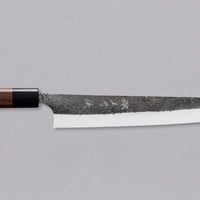

Yu Kurosaki Sujihiki Kuro-uchi 270mm (10.6")
🚩 This blade will develop patina with use, while improper maintenance may lead to rust formation.
|
✔︎ No import fees & duties (US tarrifs excluded) |

- Description
- Specifications
- Knife Care
- Shipping
Every Kurosaki blade carries his signature: a pattern of hammered "water droplets" across the steel, and like snowflakes, no two are alike. The knife you receive exists exactly once.
The sujihiki is Japan's slicing knife — a long, narrow blade built for clean, single-pull cuts through meat and fish. At 270mm it carves a roast, portions a fillet, or slices sashimi in one smooth draw, so each cut surface stays glossy and intact. If proteins are a serious part of your cooking, this is the knife that finishes the job beautifully.
Why this knife works the way it does
- Aogami Super core — One of the most respected high-carbon steels in Japan. It takes an exceptionally fine, almost gentle edge, holds it for a long time, and resharpens easily when the day comes. The trade-off: the exposed core near the edge develops a patina with use and likes to be kept dry — more on this below, it's easier than it sounds.
- San-mai stainless cladding — The carbon core is sandwiched between two stainless layers, so most of the blade is protected from rust. Carbon-steel cutting performance with a fraction of the carbon-steel maintenance.
- Long, narrow geometry — The 270mm length lets you slice in one continuous draw instead of sawing, while the narrow, thin blade glides through with minimal friction. Together they're why cuts off a sujihiki come away glossy and intact, not torn.
- Kuro-uchi finish — The dark upper blade is the untreated forge surface: an already-formed protective layer that shields the steel beneath and gives the knife its traditional look.
- Hammered tsuchime surface — Kurosaki's trademark dents aren't decoration alone; they create air pockets so thin slices release from the blade instead of clinging to it.
- Octagonal rosewood handle, black pakka wood ferrule — Light and precise in the hand, balanced for long, controlled drawing cuts.
Good to know before buying
- This is a hand-forged knife. Slight variations in the grind, finish, and hammer pattern between pieces are the nature of the craft — and the point of it.
- The exposed Aogami Super edge will develop a grey-blue patina with use. This is natural and protective, not rust. Keep the blade dry after washing and oil it occasionally.
- The kuro-uchi coating softens and wears gradually with use. Normal, and part of how the knife ages with you.
- A sujihiki is a slicer, not a cleaver: no bones, no frozen food, no twisting in the cut. Long and thin means precise — and deserving of a little respect.
- At 270mm, make sure your cutting board and knife storage can accommodate the length. A fitted saya is the safest way to store or transport it.
About Yu Kurosaki
Yu Kurosaki forges in Takefu Knife Village near Echizen, where more than ten master blacksmiths work in open view of visitors. He apprenticed under Hiroshi Kato — a smith with over fifty years at the forge and one of the Village's founders — before opening his own smithy. He is the youngest blacksmith ever granted the title of Master Nokaji by the Takefu Knife Village Association, where he now teaches as senior instructor.
His knives are sought after worldwide and we receive them in small batches. If this one is in stock, it won't be for long.
☝️ Visiting Japan? Put Takefu Knife Village on your itinerary — you can watch the forging up close.
Here's a short video from Kurosaki's workshop:
Blade shape: Sujihiki / Slicer
Steel type: Aogami Super
Blade construction: San-mai / hollow grind V-edge / tsuchime & kuro-uchi
Hardness (HRC scale): 62-63
Overall length:
Blade length: 270mm (10.6")
Blade height:
Spine thickness: 2.4mm (0.09")
Weight:
Handle length:
Handle type / wood: Japanese / Rosewood
Kanji on the blade:
Blacksmith: Yu Kurosaki
Location of the smithy: ECHIZEN - TAKEFU KNIFE VILLAGE / Fukui Prefecture / Japan
☝️ Japanese kitchen knives in our store are handmade from natural materials. Slight variations in color, texture, weight and other dimensions are possible. We try to give a good photographic representation of our products, however computer screen resolution and colors do vary, so products might not look exactly as they are seen on screen.


☝️ THIS KNIFE MAY DEVELOP PATINA
Knives made of carbon steels can, due to their low chromium (Cr) content, discolor and develop patina. The knife is the most sensitive when it is still new and a patina had not developed yet, but later, patina will protect the blade. These types of knives require a touch more care:
✔ Wipe it regularly with a clean and dry cloth (you can also do this during use).
✔ After use, rinse it with lukewarm water and wipe it dry.
✔ Coat it regularly with knife maintenance oil or plain refined sunflower oil.
✔ Store the knife by wrapping it in paper which will absorb moisture and protect the blade.
A patina is a thin layer that forms on the surface of oxidized steel and protects it from further oxidation. The patina should not be confused with rust. Patina protects the blade, while rust causes corrosion and deterioration of material, so it should be removed (see Rust erasers).
→ For in-depth information about patina, read our dedicated post on patina.
GENERAL KNIFE CARE TIPS:
Blade wear depends on the quality of steel, usage and maintenance of the blade. Japanese knives are made of high-quality steels. Follow these tips to keep your Japanese knife in top-notch shape:
✔ Use a wooden, plastic or rubber cutting board.
✔ After use, wash the knives and wipe them dry.
✔ For storage, use a knife holder or a protective knife sheath (saya).
✔ A good cutting technique is your best bet to prolong sharpness.
✔ Use sharpening stones to sharpen the knife.
❗️Don’t leave the knife in the sink. Wash it by hand.
❗️Don’t wash the knife in the dishwasher.
❗️Don’t use the knife on glass, ceramics, marble or steel surfaces.
❗️Don’t scrape the food off the cutting board with the edge of the blade. Use the spine of the knife instead.
❗️Knife is a tool intended for specific use - cutting food. It is not a can opener, screwdriver, trowel, wire cutter, hammer etc.
→ For more details, read our guide
on Maintenance of Kitchen Knives.
🤙 Contact us if you need some help. We reply within 1 business day.
SHIPPING RATES:
- €10 - flat worldwide rate with DHL Express (express delivery, 2-5 business days).
- FREE - all orders over €300 (DHL Express).
EXCEPTIONS:
See our Shipping page for more details.
DUTIES AND IMPORT TAXES:
We ship all orders DDP (duties & taxes paid). This means you will not be charged for any import fees and taxes (including VAT). All our prices are final. The price you see at checkout is the final price, no hidden costs.
DELIVERY TIME:
- Europe: 1-2 business days
- US & Canada: 2-4 business days
- Rest of the World: 3-5 business days
RETURNS:
Our return policy lasts 30 days. If more than 30 days have gone by since the day you received your order, unfortunately we can’t offer you a refund or exchange.
→ Read our SHIPPING & RETURNS policy for more info. We strive to solve any issues fast and with as little hassle for you. If you have some additional questions, please contact us.
Each knife comes with:
✔️ Instructions and knife care leaflet.
✔️ A preventive Band-Aid – the knives are very sharp! 😉
✔️ Original box from the blacksmith, which we wrap in an old Japanese newspaper sheet – so every knife is ready to be passed on as a gift as soon as it hits your doorstep!
✔️ We also offer a special gift wrapping option with the traditional Japanese washi paper.
Quiz
Still doubting which type of Japanese knife should best fit your needs?
We created a 5-steps quiz to help you find the perfect knife based on your cooking skills and the type of food you prepare.


