
A Practical Guide for Home Cooks
Best Knives for Cutting Meat

Choosing the best knives for cutting meat can completely change how you cook. A sharp, well-designed blade gives you cleaner cuts, less tearing, and more control. The result is better texture, more even cooking, and a smoother prep process.
Japanese knives are especially respected for their sharp edges and precision. When working with meat, that sharpness means clean muscle fiber cuts instead of rough tears. The texture stays intact. The slices look better on the plate. And you work faster with less effort.
Below is a practical setup for home cooks who want reliable performance from Japanese blades.
Why Japanese Knives Matter for Meat
Japanese steel is typically harder than most Western alternatives. Harder steel holds an edge longer, which means you sharpen less often and maintain consistent performance.
Sharper edges create cleaner muscle fiber cuts. Cleaner cuts preserve texture and prevent juices from escaping unnecessarily. That directly affects the quality of your final dish.
However, hard steel can be more brittle. That is why choosing the right knife style for specific meat tasks is important. Not every blade is meant for every job.

All-Purpose Meat and Vegetable Knife
Gyuto
The Gyuto is the main workhorse in many kitchens. If you want one knife that handles most meat tasks, this is often the right starting point.
Its curved edge supports rocking cuts, and the wider blade gives you good control during trimming and slicing. Most Gyuto knives come with blade lengths between 210 and 270 mm, making them suitable for home kitchens.
It works well for:
- Beef
- Pork
- Chicken
- Mixed preparation with vegetables
The Gyuto is versatile enough to replace many Western chef’s knives. Its fine edge produces smooth, clean cuts, whether you are slicing raw beef or trimming fat from pork.
![Hatsukokoro Mercury Kiri-Gyuto Kurozome Damascus 210mm (8.3") [Mono Olivewood]](http://sharpedgeshop.com/cdn/shop/files/Mercury_Kiri-Gyuto_Kurozome_Damascus_210_mm_Mono_Olivewood__420103121959_1_360x.jpg?v=1774947196)


Dedicated Slicing and Carving Knife
Sujihiki
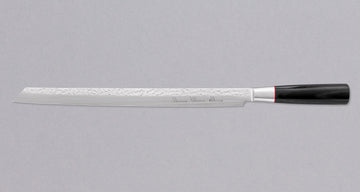
If your focus is thin, uniform slices, the Sujihiki is one of the best knives for precise meat carving.
This knife has a long, narrow blade that is slightly flexible. Its geometry is designed specifically for straight, controlled slicing.
It excels with:
- Roasts
- Ham
- Brisket
- Fish fillets
- Carpaccio
Compared to a Gyuto, the Sujihiki has a less curved edge. That flatter profile makes long, single-pull slicing easier. You achieve thinner and more consistent cuts, especially with cooked meats where presentation matters.


Hybrid Precision Knife
Kiritsuke
The Kiritsuke combines elements of a slicer and an all-purpose knife. It usually comes with a longer blade, between 240 and 300 mm, and features a flatter edge with a small, angled tip.
This design makes it suitable for larger cuts of meat and fine slicing, while still allowing light chopping.
It works well for:
- Larger cuts of beef or pork
- Thin slicing tasks
- Light vegetable prep alongside meat work
The Kiritsuke is typically recommended for intermediate to advanced cooks. Its longer blade and flatter profile require confidence and control. For those who want a premium multipurpose blade, it offers excellent precision.


Heavy-Duty Butchery Knife
Deba
The Deba is a different category entirely. It is built for heavier tasks.
With a thick spine, a robust tip, and often a single bevel design, the Deba is designed for butchery rather than slicing.
It is suitable for:
- Poultry carcasses
- Fish with small bones
- Breaking joints lightly
It is not designed for thin slicing. If your goal is delicate carpaccio or roast carving, this is not the right tool. The Deba is a butchery knife meant to handle tougher tasks with stability and power.


![Hidetsune Ryo-Deba Aogami #2 165mm (6.5") [KOB]](http://sharpedgeshop.com/cdn/shop/files/HidetsuneRyo-DebaAogami_2165mm_6.5_KOB__410101091891_1_360x.jpg?v=1764072728)

Building a Practical Setup at Home
For most home cooks, a simple combination works best:
- A Gyuto for daily preparation.
- A Sujihiki for carving and presentation.
- A Garasuki if you regularly break down poultry or fish.
This setup covers nearly all meat-related tasks while maintaining the benefits of Japanese precision. You can find all of these knives at Sharpedge Shop, where the focus is on performance, balance, and long-term sharpness.


Where Skill Meets the Blade
The Connection Between Cook and Blade
A knife is the most basic and commonly used tool in the kitchen. The right size, correct steel, good handle, and fine sharpness transform the knife into an extension of your arm.
Japanese chefs describe this connection as Jinba Ittai 人馬一体, meaning “person and horse as one body.” In cooking, it represents full unity between your arm and your knife. When the blade responds exactly as you intend, your focus shifts fully to the ingredient.
Better focus on the food leads to better food.
SharpEdge positions itself as a destination for high-performance blades. The goal is not only to offer the best knives, but also to educate food enthusiasts and serious chefs about the impact of sharpness on taste and texture. A sharp knife does not only make cutting easier. It improves consistency, preserves structure, and supports cleaner cooking techniques.
The aim is simple: everyone who works with knives in their kitchen should achieve their own personal Jinba Ittai.
When you choose carefully and use the right blade for the right task, meat preparation becomes controlled, efficient, and precise. And that precision is what defines the best knives for serious home cooking.


