


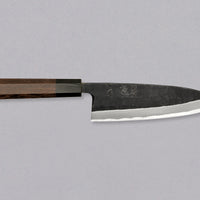
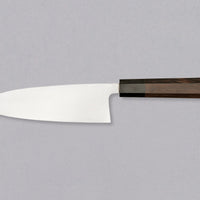
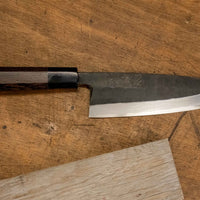
Shirasagi Deba Aogami #2 Tsuchime Kuro-uchi 180mm (7.1")
🚩 Carbon steel develops a patina with use. This is normal, but the blade must be dried well to prevent rust.
|
✔︎ No import fees & duties (US tarrifs excluded) |

- Description
- Specifications
- Knife Care
- Shipping
Shirasagi Deba Aogami #2 Tsuchime Kuro-uchi 180mm (7.1") is a Japanese kitchen knife designed for heavy-duty use — ideal for filleting whole fish, breaking down poultry, and handling other demanding butchery tasks.
The 180mm deba is the go-to choice for those who need maximum power and cutting length. As the largest size in the standard deba lineup, it’s built for tackling big fish like salmon, tuna, or monkfish — or for anyone who prefers more blade to work with when portioning poultry or prepping meat with bones. This is the blade for confident, experienced users seeking a traditional Japanese fish-processing knife that handles serious volume and heavier prep with ease.
Especially recommended for big game fishing enthusiasts!
BLADE SHAPE:
Deba is one of the “big three” traditional Japanese knives, alongside usuba and yanagiba. Designed specifically for preparing whole fish, the deba excels at:
- Cleaning and gutting
- Filleting with minimal flesh damage
- Portioning
- Cutting through smaller bones, fins, and heads
STEEL:
This knife’s core is forged from Aogami #2 (Blue #2) — a traditional high-carbon steel known for:
- Outstanding edge retention
- Smooth, precise sharpening
- Excellent performance under demanding use
Due to its carbon-rich composition, this steel can develop a patina over time and may rust if not dried properly. Regular maintenance is essential to keep it performing at its best. ⚠️ Read more about knife care here.
LAMINATION:
Ni-mai lamination method is used on single-bevel knives, where a sheet of softer metal is forge-welded onto the shinogi (front) side of the blade’s hard core. This reinforces the blade’s structural integrity and consequently makes it tougher.
GEOMETRY:
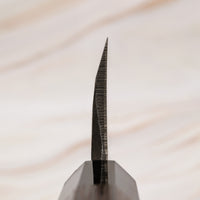
The knife is a single-bevel blade and is heavier and stronger at the handle and thinner and more precise at the tip. This blade shape makes the knife easier to use because it is very responsive, easily maneuverable, and nicely balanced. This type of blade design is also called distal taper - you can read more about it in the article on blade geometry.
BLADE FINISH:
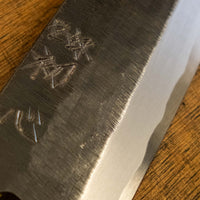
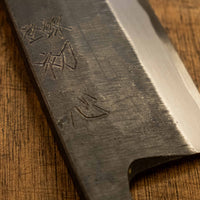
While traditional single-bevel knives are often polished to a high gloss (migaki finish), this kuro-uchi deba stands out with its more rustic appearance. The hira side (flat side of the blade) is left with a kuro-uchi finish — a layer of raw black patina that gives the knife a traditional, hand-forged character and offers protection against rust and external elements. In contrast, the urasuki side (concave back of the blade) is polished, ensuring low friction and precise, clean cuts.
HANDLE:
Japanese (Wa) style handle made out of wenge wood with a buffalo horn ferrule. The octagonal handle allows a compact and firm grip during the filleting process without slipping or causing any injuries, which is critical when working with raw fish.
|
A traditional feature of wooden handles is that over time the soft surface of the wood will lose its smoothness and shine, giving it an even better grip and making it even safer to use with wet hands. This extra friction of the "roughened" surface ensures that greasy, wet, and slippery palms don't slide forward on the blade during use. |
Blade shape: Deba
Steel type: Aogami #2
Blade construction: Ni-mai / kuro-uchi
Hardness (HRC scale): 63
Overall length: 330mm (13")
Blade length: 180mm (7.1")
Blade height: 53mm (2.1")
Spine thickness: 5.6mm (0.22")
Weight: 305g (10.8 oz)
Handle length: 137mm (5.4")
Handle type / wood: Japanese (Wa) style / Wenge
Kanji on the blade:
Blacksmith: Hatsukokoro
Location of the smithy: TOSA / Kōchi Prefecture / Japan
☝️ Japanese kitchen knives in our store are handmade from natural materials. Slight variations in color, texture, weight and other dimensions are possible. We try to give a good photographic representation of our products, however computer screen resolution and colors do vary, so products might not look exactly as they are seen on screen.


☝️ THIS KNIFE MAY DEVELOP PATINA
Knives made of carbon steels can, due to their low chromium (Cr) content, discolor and develop patina. The knife is the most sensitive when it is still new and a patina had not developed yet, but later, patina will protect the blade. These types of knives require a touch more care:
✔ Wipe it regularly with a clean and dry cloth (you can also do this during use).
✔ After use, rinse it with lukewarm water and wipe it dry.
✔ Coat it regularly with knife maintenance oil or plain refined sunflower oil.
✔ Store the knife by wrapping it in paper which will absorb moisture and protect the blade.
A patina is a thin layer that forms on the surface of oxidized steel and protects it from further oxidation. The patina should not be confused with rust. Patina protects the blade, while rust causes corrosion and deterioration of material, so it should be removed (see Rust erasers).
→ For in-depth information about patina, read our dedicated post on patina.
GENERAL KNIFE CARE TIPS:
Blade wear depends on the quality of steel, usage and maintenance of the blade. Japanese knives are made of high-quality steels. Follow these tips to keep your Japanese knife in top-notch shape:
✔ Use a wooden, plastic or rubber cutting board.
✔ After use, wash the knives and wipe them dry.
✔ For storage, use a knife holder or a protective knife sheath (saya).
✔ A good cutting technique is your best bet to prolong sharpness.
✔ Use sharpening stones to sharpen the knife.
❗️Don’t leave the knife in the sink. Wash it by hand.
❗️Don’t wash the knife in the dishwasher.
❗️Don’t use the knife on glass, ceramics, marble or steel surfaces.
❗️Don’t scrape the food off the cutting board with the edge of the blade. Use the spine of the knife instead.
❗️Knife is a tool intended for specific use - cutting food. It is not a can opener, screwdriver, trowel, wire cutter, hammer etc.
→ For more details, read our guide
on Maintenance of Kitchen Knives.
🤙 Contact us if you need some help. We reply within 1 business day.
SHIPPING RATES:
- €10 - flat worldwide rate with DHL Express (express delivery, 2-5 business days).
- FREE - all orders over €300 (DHL Express).
EXCEPTIONS:
See our Shipping page for more details.
DUTIES AND IMPORT TAXES:
We ship all orders DDP (duties & taxes paid). This means you will not be charged for any import fees and taxes (including VAT). All our prices are final. The price you see at checkout is the final price, no hidden costs.
DELIVERY TIME:
- Europe: 1-2 business days
- US & Canada: 2-4 business days
- Rest of the World: 3-5 business days
RETURNS:
Our return policy lasts 30 days. If more than 30 days have gone by since the day you received your order, unfortunately we can’t offer you a refund or exchange.
→ Read our SHIPPING & RETURNS policy for more info. We strive to solve any issues fast and with as little hassle for you. If you have some additional questions, please contact us.
Each knife comes with:
✔️ Instructions and knife care leaflet.
✔️ A preventive Band-Aid – the knives are very sharp! 😉
✔️ Original box from the blacksmith, which we wrap in an old Japanese newspaper sheet – so every knife is ready to be passed on as a gift as soon as it hits your doorstep!
✔️ We also offer a special gift wrapping option with the traditional Japanese washi paper.
Still not sure?
Take our 5-step quiz and find your match
Get a personalised recommendation.
Take the quiz