


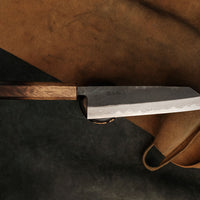
Naoto Kitaoka Bunka Aogami #1 Damascus Kuro-uchi 180mm (7.1")
🚩 Carbon steel develops a patina with use. This is normal, but the blade must be dried well to prevent rust.
|
✔︎ No import fees & duties (US tarrifs excluded) |
- Description
- Specifications
- Knife Care
- Shipping
Naoto Kitaoka Bunka Aogami #1 Damascus Kuro-uchi 180 mm is a versatile hand-forged Japanese kitchen knife that combines traditional forging techniques from the Tosa region with a refined finish. Its Aogami #1 steel core takes a fine edge, retains sharpness well and is relatively straightforward to sharpen.
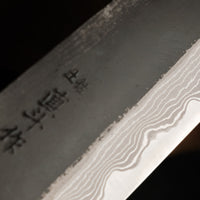
The contrast between the dark kuro-uchi finish and flowing damascus pattern highlights the character of the hand-forged blade. A burnt oak handle completes its rustic appearance. With its 180 mm blade, this bunka is a practical choice for everyday preparation of vegetables, meat and fish.
BLADE SHAPE:
Bunka is a versatile Japanese kitchen knife recognised by its wide profile, relatively flat cutting edge and distinctive k-tip. The flatter section works well for chopping and push cuts, while the pointed tip is useful for precise cuts and smaller ingredients.
At 180 mm, the blade offers enough cutting length for most everyday tasks while remaining easy to control. It is suitable for vegetables, boneless meat and fish, especially for cooks who want an all-round knife with added precision at the tip.
STEEL:
The blade has an Aogami #1 core, a traditional Japanese high-carbon steel known for taking a fine edge, retaining sharpness and being relatively easy to sharpen on whetstones.
Aogami is reactive rather than stainless. The exposed core will gradually develop a patina during use. Wash the knife by hand, dry it immediately and do not leave it in water or a damp environment. For longer storage, apply a thin layer of blade oil.
LAMINATION:
The hard Aogami #1 core is surrounded by layers of softer steel. This construction supports and protects the harder core, while the layered steel creates the blade’s damascus pattern.
The outer layers and exposed core are reactive, so the blade’s appearance will change with use. Proper care helps prevent rust, while a natural patina gives each knife its own character over time.
GEOMETRY:
The blade has a symmetrical double bevel and is suitable for both right- and left-handed users. Its defining feature is a pronounced distal taper: the spine narrows from 3.5 mm at the heel to 1.6 mm towards the tip.
The thicker heel provides stability, while the thin front section allows precise cuts with little resistance. This combination makes the knife useful across a range of vegetable, meat and fish preparation tasks.
The thin tip requires care. Avoid bones, frozen food and other very hard ingredients, and do not twist the blade or put sideways pressure on it while cutting.
BLADE FINISH:
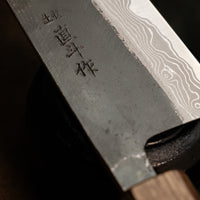
The blade combines a dark kuro-uchi finish with a flowing damascus pattern. Kuro-uchi is the dark surface retained after forging. It gives the knife its traditional, rustic appearance and reduces the exposure of the reactive steel, though it does not make the blade rustproof.
The layered damascus pattern is most visible on the lower part of the blade, creating a contrast with the darker surface above. As each knife is made by hand, the pattern and finishing marks vary slightly from blade to blade.
HANDLE:
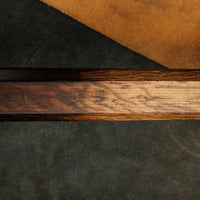
The knife has a traditional Japanese wa handle made from burnt oak. The heat-treated surface brings out the wood grain, while its darker tones complement the blade’s kuro-uchi finish.
The lightweight handle contributes to the knife’s agile feel. Its symmetrical shape is comfortable for both right- and left-handed users.
BLACKSMITH:
Naoto Kitaoka is a Japanese blacksmith from Kochi Prefecture in the Tosa region. He continues a family forging tradition spanning four generations. His family originally made traditional Japanese sickles and other agricultural blades. Naoto learned the craft alongside his grandfather for around twenty years before focusing on kitchen knives.
He uses traditional Tosa forging techniques while developing his own style. He pays particular attention to heat treatment, preventing decarburisation and final grinding, believing that the quality of the forging becomes fully apparent during the later stages of blade making.
His carefully finished kuro-uchi surface is another distinctive feature. He aims for a more even, refined appearance while retaining the character of a hand-forged knife.
Blade shape: Bunka
Steel type: Aogami #1
Blade construction: San-mai
Blade finish: Kuro-uchi / Damascus
Hardness (HRC scale): 62-63
Overall length: 322mm (12.7")
Blade length: 180mm (7.1")
Blade height: 45mm (1.8")
Spine thickness: 3.2mm (0.13")
Weight: 142g (5 oz)
Handle length: 127mm (5")
Handle type / wood: Japanese Wa Handle / oak
Kanji on the blade:
Blacksmith: Naoto Kitaoka
Location of the smithy: TOSA / Kōchi Prefektura / Japan
☝️ Japanese kitchen knives in our store are handmade from natural materials. Slight variations in color, texture, weight and other dimensions are possible. We try to give a good photographic representation of our products, however computer screen resolution and colors do vary, so products might not look exactly as they are seen on screen.


SHIPPING RATES:
- €10 - flat worldwide rate with DHL Express (express delivery, 2-5 business days).
- FREE - all orders over €300 (DHL Express).
EXCEPTIONS:
See our Shipping page for more details.
DUTIES AND IMPORT TAXES:
We ship all orders DDP (duties & taxes paid). This means you will not be charged for any import fees and taxes (including VAT). All our prices are final. The price you see at checkout is the final price, no hidden costs.
DELIVERY TIME:
- Europe: 1-2 business days
- US & Canada: 2-4 business days
- Rest of the World: 3-5 business days
RETURNS:
Our return policy lasts 30 days. If more than 30 days have gone by since the day you received your order, unfortunately we can’t offer you a refund or exchange.
→ Read our SHIPPING & RETURNS policy for more info. We strive to solve any issues fast and with as little hassle for you. If you have some additional questions, please contact us.
Each knife comes with:
✔️ Instructions and knife care leaflet.
✔️ A preventive Band-Aid – the knives are very sharp! 😉
✔️ Original box from the blacksmith, which we wrap in an old Japanese newspaper sheet – so every knife is ready to be passed on as a gift as soon as it hits your doorstep!
✔️ We also offer a special gift wrapping option with the traditional Japanese washi paper.
Still not sure?
Take our 5-step quiz and find your match
Get a personalised recommendation.
Take the quiz